Botanic Drawing & Painting (Beginners to Intermediate)

A beginner-to-intermediate course in botanical illustration covering graphite, pen and ink, watercolour, botanical forms, shading and composition.
About this course
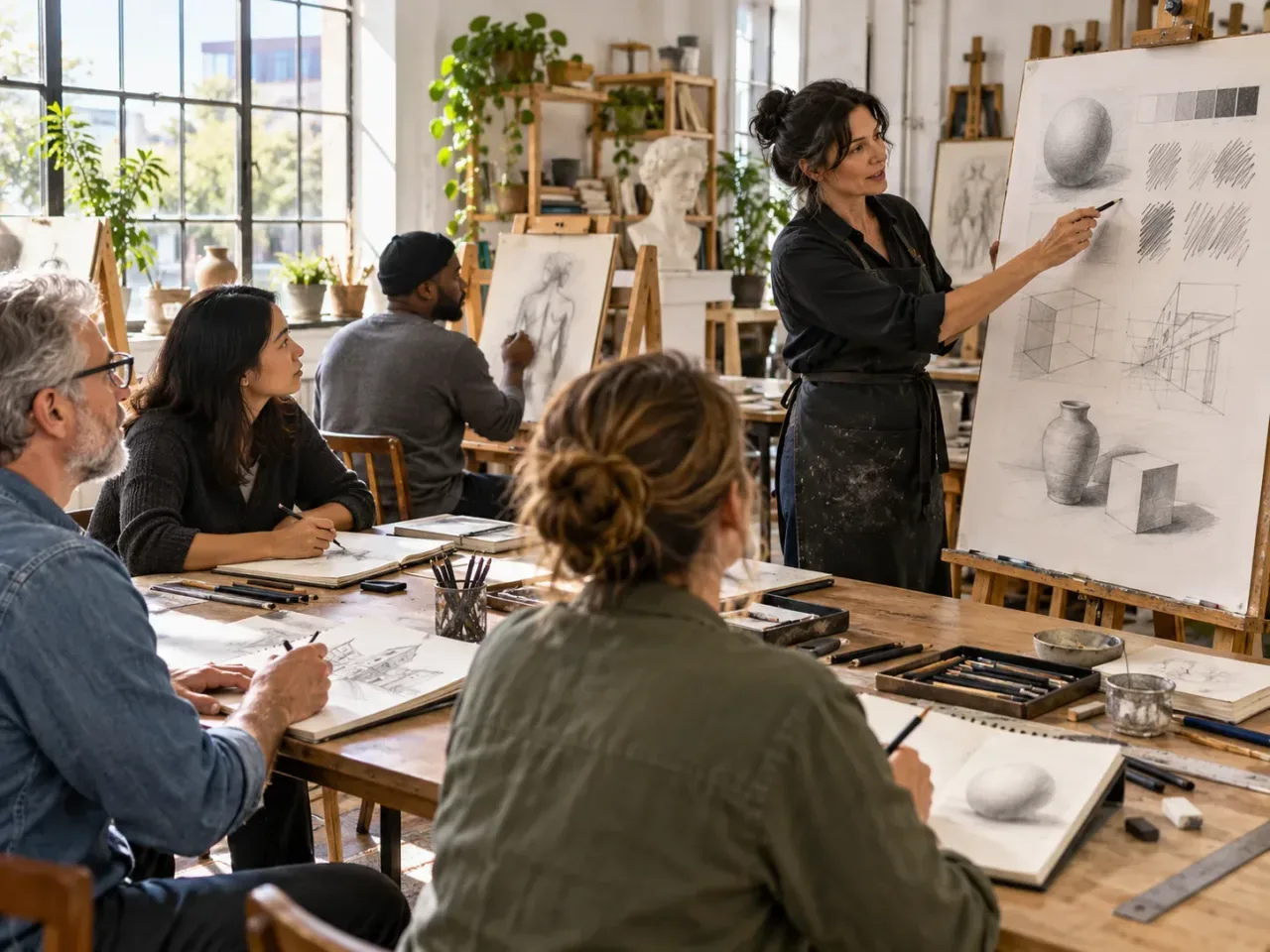
The course examines how leaves, flowers, fruits, nuts, bulbs, roots, corms and rhizomes can be represented through line, form and tonal shading. Learners develop observational drawings and diagrams, considering how light describes three-dimensional plant structures and how illustrations are arranged on the page. Instruction progresses from graphite techniques to pen and ink, with watercolour introduced as appropriate. Basic botanical knowledge is included to inform the drawings, while continuing learners can build on work from the previous semester.
What you'll learn
- Apply line, form and shading techniques to botanical drawings.
- Use graphite to develop botanical illustrations with attention to structure and tone.
- Create pen-and-ink line drawings and diagrams to support botanical illustration.
- Represent plant forms by analysing how light and shade describe their surfaces.
- Compose illustrations of botanical specimens for a chosen visual outcome.
Is this course right for you?
The course is intended for beginner to intermediate botanical illustrators, as well as continuing students. The beginner level indicates that foundational techniques are included, while the course also allows more experienced learners to extend their work and explore additional media.
- Continuing students can resume work from the previous semester.
- The course covers both foundational drawing principles and more developed botanical illustration techniques.
Before you go
- A notebook that can also serve as a sketchbook is required; A5 to A4 with smooth, heavy-duty paper is recommended.
- Drawing materials include plate-finish Bristol Board or bleed-proof layout paper, artist-quality graphite pencils, a sharpener and a kneadable eraser.
- Learners continuing with pen and ink will need fine-liner pens in 0.05, 0.1, 0.3 and 0.5 tip sizes.
- Learners intending to work in watercolour need smooth, hot-pressed 300gsm watercolour paper, preferably 100% cotton. Paper will not be stretched in class.
- A magnifier is recommended for viewing fine detail and reducing eye strain, although drawing and painting without magnification is possible.
Class teacher
Svetlana Lanse
Class teacher
Where this course runs
Putney School of Art and Design
Art and design short courses in Putney
15 drawing courses on Learn.LondonUpcoming classes
1 class
Selected date
Mon 11 Jan 2027
10:00 – 13:00
£313
PSAD Main Site, Putney