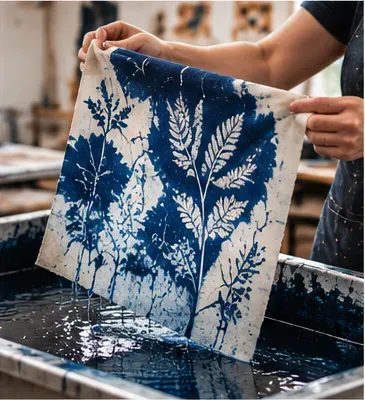
Textiles: indigo shibori dyeing

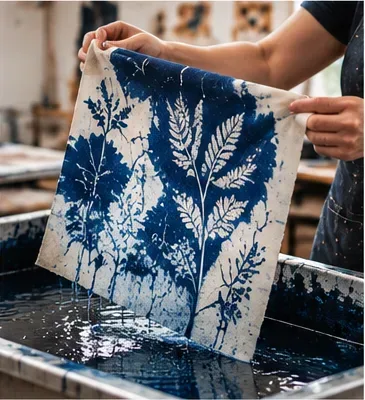


An all-levels workshop exploring indigo dyeing and shibori resist techniques through demonstrations, guided making and experimental fabric samples.
About this course
The workshop introduces indigo’s history and properties alongside the process of preparing fabric and setting up a dye bath. Participants explore shibori methods including folding, pleating, clamping, stitched resist, binding and pole wrapping to create patterned cloth with varied depths of colour. Teaching combines practical demonstrations, examples, historical and cultural references, and one-to-one support while samples are developed. The resulting pieces may be developed into a larger textile or experimental patchwork. Handouts, books and fabric samples provide technical and contextual reference during the workshop.
What you'll learn
- Prepare an indigo dye bath and fabric for dyeing
- Produce cloth with varied depths of indigo through immersion dyeing
- Apply folding, pleating, clamping, stitched-resist and wrapping techniques to create patterns
- Explain selected historical and cultural aspects of indigo and shibori
- Develop dyed samples into a larger piece or series where relevant experience supports this
Is this course right for you?
The course is open to learners of all abilities and uses basic techniques with technical instruction. Participants should be able to follow simple written and verbal instructions alongside demonstrations and take part in group discussion. Learners with some experience can use the methods as a starting point for developing a larger piece or series.
- Suitable for learners at all levels
- Requires following simple written and verbal instructions
- Includes group discussion as well as individual practical support
- Learners with some experience may develop a larger piece or series
Before you go
- Basic materials and protective clothing are provided.
- Participants may bring fabric scraps in natural fibres such as silk, cotton, wool or linen, along with undyed needles and threads, string, rubber bands and sample markers such as buttons, beads or safety pins.
- Old clothes or an overall are recommended because the work is messy; participants may also bring their own rubber gloves or apron.
- A sketchbook or notebook may be used to record methods and references.
Class teacher
Lara Mantell
Class teacher
Where this course runs
Upcoming classes
1 class
Selected date
Wed 7 Apr 2027
10:30 – 16:30 • 3 weeks
£249
Keeley Street, Covent Garden