
City Lit Absolute Beginners Singing course review
Absolute beginner singing at City Lit: what it is like to sing in front of a group
I attended all three 90-minute sessions, progressing from nervous group warm-ups to singing a verse of Roger Quilter’s ‘Moonlight’ alone.

I did not leave convinced that I was a good singer. I left convinced that I needed to sing.
Why I booked an absolute beginner singing course
I do not think I could have booked singing before taking acting classes. Acting had begun changing my relationship with fear. It showed me that entering a room of strangers and attempting something vulnerable could lead to energy, connection and a fuller experience of London.
Singing felt like another level of exposure. In acting, I could inhabit a character or concentrate on a scene partner. A singing voice felt more difficult to hide behind. The sound would come directly from me, and I did not know whether it would be any good.
I did know that I liked singing. The problem was allowing anybody else to hear me. Singing felt unusually exposing because there was no character, script or scene partner to hide behind. It would simply be my voice, and I did not know what would happen when I opened my mouth in front of other people.
I was not looking for a generic confidence exercise involving music. I wanted to discover whether I could learn to use my voice, enjoy singing with other people and become less afraid of being heard. The three-session format made that frightening experiment feel manageable. At £79, it offered more than a one-off taster without requiring a full term’s commitment.
What the lessons involved
Sessions began with vocal warm-ups and exercises, sometimes supported by the piano and sometimes unaccompanied. We explored sounds, moved between lower and higher notes and tried to release tension.
Trevor often explained vocal ideas through images. He described opening doors to let the music in rather than simply pushing sound out. At another point, he asked us to imagine floating in a swimming pool so that changes in volume did not become physical strain. These images turned unfamiliar instructions into sensations I could attempt.
After roughly 30 to 45 minutes, an accompanist joined us. This allowed Trevor to step away from the piano, face the class and concentrate fully on our singing. Having both a tutor and a live accompanist made the course feel more substantial than a casual group singalong.
The songs included a traditional tune, ‘Love Me Tender’, ‘Edelweiss’, the nursery rhyme ‘Oliver Cromwell’ and Roger Quilter’s setting of ‘Moonlight’. We sometimes sang the lyrics and sometimes replaced them with ‘la’ so we could concentrate on the notes. Trevor also introduced enough musical understanding to explain why an exercise mattered, without attempting to teach music theory in depth.
Lesson one: waiting for my name to be called
I tried to arrive exactly on time for the first session. By the time I reached the classroom, the door was already closed. Opening it and entering late added an unnecessary burst of stress to an experience that already felt exposing.
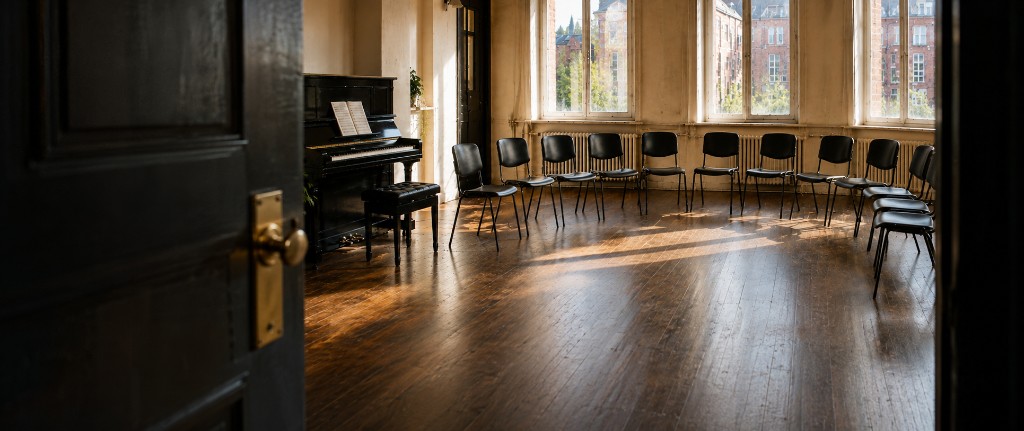
Inside, 12 students were seated around the room. There was a piano to one side and Trevor stood at the front. One seat remained. I smiled, said hello and found my place. The response was welcoming.
We introduced ourselves and explained why we had come. Some people had sung when they were younger, some had tried another beginner course and others appeared to be starting from scratch. Four people explicitly mentioned fear, nervousness or wanting to become more comfortable singing in front of others. The levels of experience varied, but being heard seemed to be a significant part of why many of us were there. The atmosphere was smiley and supportive, yet there was a shared apprehension beneath it.
Trevor acknowledged that early. Most singing would happen together, but he might ask us to sing a short phrase alone. Participation was optional, although individual singing formed part of the learning. Nobody was forced to perform, but nervousness was not treated as a reason to remain permanently hidden inside the group.
I expected individual singing to come much later. During the first lesson, however, Trevor began calling people one by one to repeat a short pattern of notes.
Objectively, it was tiny. Emotionally, waiting for my name made the pressure build. At first I listened carefully to the other students. As more people took their turns, I increasingly wanted mine to be over.
When my name was called, I made the sound. It was frightening but satisfying. Once it was done, the rest of the class felt easier. Trevor offered a pointer and invited me to try again, making the turn feel like teaching rather than a test of who already possessed the best voice.
We then learnt songs as a group, finishing with the first verse of ‘Moonlight’. At the end, people began talking as we left. One student said they had given themselves permission not to return if the experience felt like too much. That captured the vulnerability in the room. Many people were frightened in ways that were not immediately visible.
Lesson two: singing in smaller groups
I arrived early for the second session and recognised another student in the lift. We spoke on the way to the classroom about why we had joined and the other things we were trying. That small interaction made the class feel less like a room of anonymous faces.
Three of the 12 students from the first lesson did not return. I do not know their individual reasons, but I could understand why someone might find it difficult to come back. Classes involving singing or performing can make you feel vulnerable very quickly. I have been the person who did not return, particularly with improv. It does not mean you have failed or that the activity is not for you. Sometimes you need to try a different class, or simply try again when you feel ready.
After warming up, we completed another short individual vocal exercise. This time, we stretched the word ‘soft’, moving the sound up and down before articulating the final ‘t’. Waiting for my turn remained stressful, but completing it brought the same sense of release.
We then returned to ‘Moonlight’, and Trevor divided the room into numbered groups. Each group sang a different verse while the students immediately beside us remained silent. We were still singing with other people, but we no longer had the protection of the entire class. It was a clever intermediate step between singing together and singing alone.
Trevor then told us that, in the final session, we would have the option of singing one verse individually. The prospect increased my anxiety, but knowing a week in advance also gave me time to prepare.
Lesson three: singing a verse alone
We were not required to memorise the verse, but I decided to learn the words and rehearse. That preparation created a different kind of nervousness. When I am completely unprepared, I can tell myself that a poor result does not mean much. This time I had worked. I thought I might do it reasonably well, which created the additional fear that it could still go wrong in front of everybody.
By the morning of the third session, I had two competing feelings. I was frightened of singing alone, and I genuinely wanted the opportunity to try.
Around eight students attended the final lesson, compared with 12 at the beginning. People were chatting before the start and some had begun exchanging numbers. Three weeks was not enough to create a close community, but familiarity had softened the room.
Trevor acknowledged that the session could feel stressful and reassured us that he would support us through it. We began with warm-ups and completed two short individual vocal exercises, compared with one in the earlier sessions. Each week, he was asking us to carry slightly more of the sound alone.
During one exercise, my first attempt did not work. I tried again and the second one did. That small recovery mattered. An imperfect sound was not a catastrophe. I could receive guidance, repeat the exercise and produce something different.
Once the accompanist joined, we sang ‘Moonlight’ together twice. Then came the individual verses. When I sang mine, Trevor told me what I had done well. I had no doubt that I was not yet a great singer, but hearing that something in my performance had worked felt genuinely good. Being asked to repeat part of it created a new wave of pressure, but I completed it again.
I did not experience a cinematic disappearance of fear. The moment was valuable precisely because I remained frightened and did it anyway.
The moment was valuable precisely because I remained frightened and did it anyway.
Trevor’s teaching and what I found difficult
Trevor’s strongest quality was the way he combined reassurance with direction. He made participation optional and did not turn the room into an audition, but each lesson contained a small moment of individual singing. The tasks moved from a few notes, to a word, to smaller groups and finally to a verse alone.
His feedback was necessarily brief because individual attention had to be shared across the group. For a three-session introduction, it felt sufficient. Students seeking detailed analysis of their vocal technique or extended one-to-one coaching would need a different format.
Waiting for my turn was the hardest part. Because Trevor did not always follow a fixed order, I sometimes became preoccupied with whether my own sound would emerge correctly instead of concentrating on other students. Learning to remain present while waiting is another skill, and I did not master it in three weeks.
What changed after three lessons
In the full group, I became more confident. I increasingly enjoyed singing with everybody and felt able to contribute rather than hide inside the collective sound. Alone, the answer was more complicated. I was still extremely nervous, particularly while waiting or attempting a sound I could not rehearse.
What improved was my competence and my evidence. I had made unfamiliar sounds, listened to feedback and tried again. I had learnt that practising during the week made the exercises easier. I had sung a complete verse in front of other students and survived the moments when a sound did not emerge as intended.
The course gave me conviction more than confidence. I did not finish certain that I was good at singing. I finished certain that singing made me happier and that I wanted to continue learning.
The course gave me conviction more than confidence.
After the final session, I walked out with two other students. We discussed what had helped, what had been difficult and what each of us might try next. There was something sad about saying goodbye. A short adult course creates a temporary version of life: strangers enter a room, attempt something together, begin to know one another and then disperse.
I left feeling relieved, softer and happy. Singing involves making sounds that ordinary life rarely asks us to make. Afterwards, London seemed brighter. It felt as though I were walking around the city wearing colourful, happy-tinted glasses. That emotional result does not prove technical progress, but it explains why continuing matters to me.
Was it good value?
Three sessions were enough for an absolute beginner introduction. I would describe the course as a long taster: substantial enough to reveal the teaching process, group experience and emotional challenge, but far too short to develop a trained voice.
I paid £79 for three 90-minute sessions. Given the live accompanist, structured progression, opportunities for individual feedback and the fact that I completed a genuine solo challenge, I consider that very good value. A single workshop would not have created the same sense of returning, practising and attempting slightly more.
Who should take it?
I would particularly recommend the course to:
Likely to suit
- complete beginners who enjoy singing but feel frightened of being heard;
- adults who want to learn rather than simply join a casual singalong;
- people who respond well to structured, gradual progression;
- nervous students who want supported opportunities to sing briefly on their own; and
- anyone unsure whether they are ready to commit to a longer course.
May not be right
It may be less suitable for experienced singers who want detailed technique, extensive individual coaching or challenging repertoire. It is also unlikely to suit somebody seeking only the anonymity of singing familiar songs inside a large group.
Students who feel intensely nervous should know that individual singing was optional in my cohort. They should also know that the course worked by gently encouraging us towards it. For me, that was its principal benefit.
My verdict
City Lit’s Absolute Beginners Singing course took the word ‘beginner’ seriously. It did not assume that students understood vocal technique, could read music or felt comfortable singing in public. It began with simple sounds and group support, then gradually reduced the protection of the group.
Its greatest success was giving the three sessions a destination. The individual notes prepared us for a word, the smaller groups prepared us for greater exposure and the rehearsed verse gave us a concrete final challenge.
The fear did not disappear, and the dated repertoire was a limitation. Three sessions could offer only brief feedback and foundational exercises. This was not a vocal transformation. It was a well-designed beginning.
After the final class, Trevor explained the available Singing 1 courses and their different teaching styles. I planned to continue in September because structured progression works for me and I wanted more exposure rather than a return to zero.
I began wondering whether I could sing in front of other people. I finished without a definitive answer about the quality of my voice, but with a better answer to a more important question: did I want to keep singing?
Yes.
The course did not make singing unfrightening. It made the next step feel possible.
Where this class led next
- Absolute Beginners Singing
- Singing 1
- Further singing and voice
Find the course
- Browse City Lit singing classesAbsolute Beginners Singing dates vary by term; check current City Lit listings via Learn.London.
- View City Lit Singing 1 class page
- View the City Lit provider page
- Browse more first-hand reviews